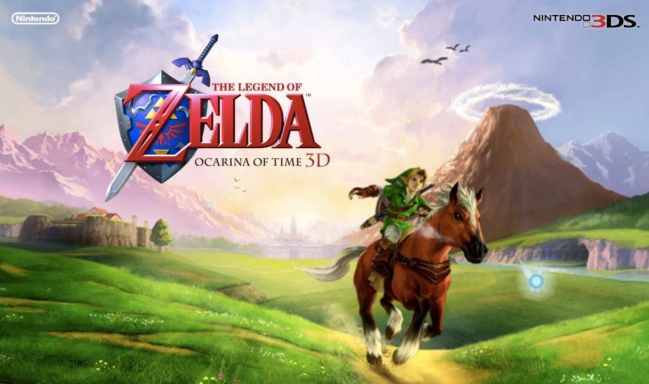
The Legend of Zelda: Ocarina of Time Review

the-legend-of-zelda-ocarina-of-time-3d-wallpaper1

I have a theory that if someone plays a video game franchise for a long time that one game from that series will come to mind due to nostalgia whenever they think about that series. The Legend of Zelda: Ocarina of Time is that game to me since that’s the first The Legend of Zelda game I have played.


Now some of you may think that I’ll say that The Legend of Zelda: Ocarina of Time is the greatest game ever. Well, if you asked me when I first played it as a kid, I probably would said it that. However, now that I’m older, I wouldn’t go that far. Don’t get me wrong. It’s a decent game, but I wouldn’t go so far to call it a masterpiece.


The Legend of Zelda: Ocarina of Time was originally released in 1998 for the Nintendo 64. It was then released on the GameCube a few years later as part of The Legend of Zelda: Collector’s Edition. It was later released for the Virtual Console on the Wii and was remade for the Nintendo 3DS.


Like all Legend of Zelda games, this game follows a boy name Link. After removing a curse from the Great Deku Tree, Link is sent to go see Princess Zelda. Upon meeting her, she informs our hero that she believes that Ganondorf, the prince of the Gerudo tribe, is after the holy relic, the Triforce. Her reason of thinking this is that she has been having terrible dreams lately. She then asks Link to get the three Spiritual Stones before Ganondorf does.


After getting the Spiritual Stones, Link returns to Hyrule Castle to see Ganondorf chasing after Zelda and her bodyguard, Impa. Seeing Link, Zelda tosses the Ocarina of Time to him. Once they’re gone, Link grabs the ocarina and receives a telepathic message from the princess. She tells him to play the Song of Time in the Temple of Time, and protect the Triforce. Once Link plays the song, a secret door opens to reveal the Master Sword. The moment that Link pulls the sword from its pedestal, Ganondorf appears and claims the Triforce for himself.


Link is then greeted by Rauru, the sage of light. He informs our hero that when he pulled the Master Sword, he was too young to wield it and defeat Ganondorf. So Link was sealed for seven years while the Gerudo prince transformed Hyrule into a land of darkness. Now Link must find and awaked five out of the seven sages so they can imprison Ganondorf in the Sacred Realm.


Like Final Fantasy VII, The Legend of Zelda: Ocarina of Time is the first Zelda game with 3D graphics. Some people may find the graphics haven’t aged well. However, due to the time that it was released and the system it was on, they aren’t that bad. Now the graphics for the Nintendo 64 and the GameCube versions are the same expect for the design of the Mirror Shield. When it was released for the Nintendo 3DS, the graphics got an upgrade.


During your play through, you’ll gain some items to aid you. For the Nintendo 64, you can equip these items to three of the four C buttons, while it’s the C analog stick for the GameCube. On the Nintendo 3DS, not only can you equip items to the X and Y buttons, but there are two additional buttons on the touch screen to equip items. Also, the ocarina gets its own button on the 3DS while, on the Nintendo 64 and the GameCube, you have to equip it to one of the C buttons.


Now during the game, you’ll have to travel through time. Because of this, there are some items you can use as both a child and an adult while there’re some items that you can only use as a kid or an adult. For example, you can use bombs as both a kid and an adult. However, you can only use the hookshot as an adult while you can only use the slingshot as a kid.


Some players may find The Legend of Zelda: Ocarina of Time to be very linear. I don’t mind for it to be like that. But, I do understand how they feel since I have played this game about twenty times, and it doesn’t help your fairy companion, Navi, is talking you where go next every now and then. However, there are some side quests that you can play if you want to take a break of the main story. For example, you can collect all thirty-six heart pieces and collect all one hundred gold skulltula. Now, you don’t have do all the side quests to complete this game.


Throughout the game, there are puzzles to solve to get through each dungeon. They’re easy to solve. However, the Water Temple on the Nintendo 64 and the GameCube is very difficult, and it’s easy to get lost. Luckily, the Water Temple on the Nintendo 3DS is easy to get through.


Now there is a harder version of this game known as The Legend of Zelda: Ocarina of Time Master Quest. It was original going to be release on the Nintendo 64DD, an add-on for the Nintendo 64. However, it was never release until the GameCube. It was on a special bonus disk when you pre-order The Legend of Zelda: The Wind Waker. It was release again on the Nintendo 3DS’s Ocarina of Time, but you had to beat Ocarina of Time to unlock Master Quest.


Overall, The Legend of Zelda: Ocarina of Time is a good game, but there are slightly better ones from this series. Despite how easy the dungeons and bosses are, this game is worth play at least once. If you’re wandering which version of this game to get, it all depends on which system you have and how much you’re willing to pay.

Image

R.I.P. JewWario

290px-JewWario

Early today, I caught wind of the death of Justin Carmical. For those who don’t know who he is, he is known as JewWario online, and he reviews import Japanese video games that people can play without knowing any Japanese. Justin took his own life on January 23, 2014 at the age of 42. His wife, Jenny Valentine, had said on Facebook:

“He knew I loved him, He knew all of you loved him. You all made him so happy, every time he was recognized from his videos, it made him giddy with joy.” 

Although I never met or knew him personally, I do wish I had. He seems like a fun guy to know and/or be friends with. His family will be my prayers. Rest in Peace, JewWario. You will be miss by your fans and fellow reviewers.

Suikoden II

1329636-00

When Suikoden was first released in Japan in 1995, I believe the creators didn’t know how well the game would sell. As a result to the surprise success of Suikoden, a sequel was made. Suikoden II is set three years after the original game, but this time taking place at the Jowston League of City-States and the Highland Kingdom which are location north of the Scarlet Moon Empire.

The hero in this game is a young boy named Riou. He and his friend, Jowy, are part of the Unicorn Brigade; an army consists of youths who serve the Highland army. The City-States has formed a cease fire with the Highland Kingdom. However, just when everything seemed to be peaceful, a rain of arrows showers down on the camp that Riou and Jowy are stationed at. During the chaos, the two friends discover a shocking truth behind the attack. It seems that the one responsible for the ambush is none other than Luca Blight, Prince of the Highland Kingdom, who plans to rekindle the hatred between the two troubled nations. After learning the awful truth, Riou and Jowy run for their lives, and blindly jump off a cliff into a river. Little did they know, the river currents will separated them, and they will forever change the destiny of the two nations. The two friends end up working separately through the ranks of each country, eventually rising as their leaders.

While the first Suikoden dealt with a corrupt government and military, Suikoden II deals with “brother verses brother”, a theme which rarely is explored in video games. Though Jowy and Riou aren’t blood related, the two are childhood friends and do act like brothers. As the game progresses, the player can see how the war affects these two characters greatly.

Like the first Suikoden, there are 108 characters to recruit, and you don’t have to get all of them to beat the game. About two-thirds of the recruiting characters in Suikoden II are new while about a third of them have made a reappearance from the previous game. There is a little bonus to this game. If you saved at the last save point in Suikoden, you can transfer the game data to Suikoden II, and you can meet Tir McDohl (the hero from Suikoden). If you got all 108 characters in the first game, you can also meet Tir’s traveling buddy. Both characters can join your party, but they’re not part of the recruiting characters.

The graphics of Suikoden II are a total upgrade from Suikoden. There’s a little more detail in the background and characters. Even the opening gets an upgrade. Where Suikoden’s opening is mostly spirits and some game play footage, the intro of Suikoden II is mostly hand drawn, almost animated, with some CGI.

Like the first Suikoden, there 3 types of battles: Basic Battles, 1-on-1 Duels, and War Battles. While the Basic Battles is about the same in both games, there are some changes with the duels and the War Battles. The only thing that has change for the duels is that the “Desperate Attack” has changed to “Wild Attack.” For the War Battles, there is a major difference between the two games. The War Battles in Suikoden is basically a menu base battle where each turn you choose an action and then a group or character that is listed under that action. The War Battles in Suikoden II, however, is more tactics. You can move the characters and choose which action they should do.

There is one small improvement with the endings. Where Suikoden had 2 endings that had very little differences between them, Suikoden II had 3 endings. Fans of this series call the 3 endings: bad, good, and perfect, because, depending how many of the recruiting characters you got, determines each ending you get. However, the bad and good endings of Suikoden II is similar to Suikoden by being about the same but slightly different. Both endings have Riou becoming the leader of a new country. The difference between the two is that with one ending you choose to be the new leader, and, with the other one, you’re force to become the new leader. The perfect ending is just Riou traveling the world with two people.

There is a spin-off Suikoden game called Gensō Suikogaiden. This game is a two part series that follows Nash. This game takes place during and after Suikoden II. Suikogaiden is more of a visual novel than role playing game. However, to my knowledge, Suikogaiden was never released outside of Japan. So people outside Japan won’t met Nash until Suikoden III.

Overall, Suikoden II is a good sequel that you don’t have to play the previous game. Like the Suikoden, if you like to play this game, you’re most likely have to borrow from someone, because the cost of Suikoden II is over $100.